
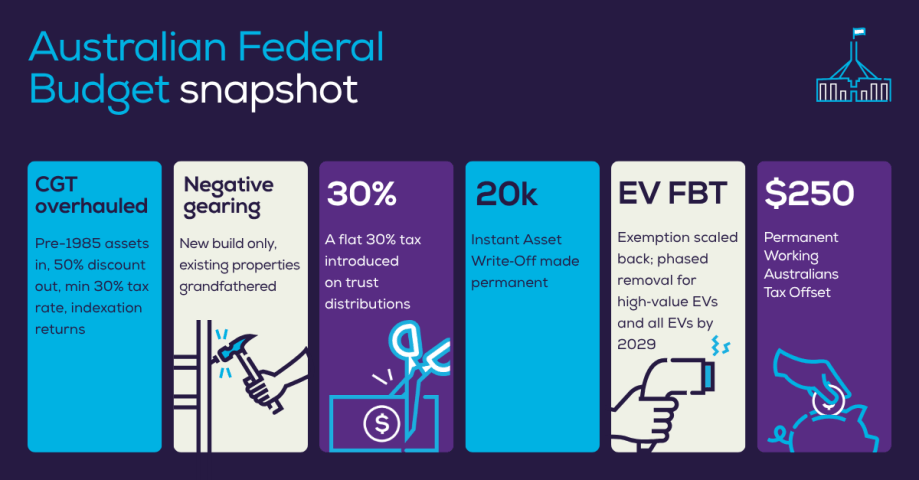
The 2026-27 Federal Budget, delivered by Treasurer Jim Chalmers on the evening of 12 May 2026, is one of the most significant overhauls of the Australian tax system in nearly three decades. In a single budget, the Government has made changes to capital gains tax, negative gearing, trust distributions, superannuation, electric vehicles, research and development, and a range of cost-of-living measures. Almost every one of our clients will be affected in some way. The centrepiece of the Budget is the replacement of the 50% capital gains tax (CGT) discount with cost base indexation for gains arising from 1 July 2027, combined with a new 30% minimum tax on net capital gains. This is effectively a return to the approach that applied in Australia from 1985 to 1999. The change has wide-reaching consequences for property investors, business owners, and anyone who holds assets that have grown in value.
What makes this Budget particularly complex is that many of these changes interact with each other. The impact of the CGT changes, for example, is magnified when combined with the negative gearing changes and the new trust distribution rules. For many clients, the combined effect is considerably larger than any single measure considered on its own.
This newsletter sets out the key measures and what they mean for you. We have focused on the practical implications rather than the fine technical detail. Many of these changes are still subject to draft legislation and a number of details are not yet fully confirmed.
What is clear is that these changes are significant, they are broad, and for many clients they will require a review of existing arrangements. We encourage you to read through the articles that follow and to contact us to discuss anything that may be relevant to your situation.

Changes to Negative Gearing — What Property Investors Need to Know
Negative gearing has been a cornerstone of Australian property investment strategy for decades. The 2026-27 Budget confirms changes that will affect investors who own or are planning to acquire investment properties — though the impact will vary significantly depending on your current position.
What Is Negative Gearing?
Negative gearing occurs when the costs of owning an investment property — including loan interest, property management fees, maintenance, council rates, and depreciation — exceed the rental income it generates. Under the current rules, that net loss can be deducted against your other income, including salary or wages, reducing your overall tax bill.
What Has Changed
Existing investment properties are fully protected. If you already own a negatively geared investment property, your ability to offset those losses against your other income will continue unchanged for as long as you hold that property. For established residential properties acquired after 7:30pm AEST on 12 May 2026, the rules change from 1 July 2027. Losses from these properties will only be deductible against rental income or capital gains from residential properties — they cannot be used to reduce your salary or wage income. An exception applies for new builds: negative gearing deductions remain fully available for newly constructed properties.
Who Is Affected
If you own existing investment properties and have no plans to acquire more, the practical impact is limited. The change becomes relevant when you consider your next acquisition. Any established residential property purchased after 7:30pm on 12 May 2026 will be subject to the new quarantining rules from 1 July 2027. Contracts entered into before that time — including those not yet settled — are covered by the grandfathering provisions.
The Combined Effect
For a high-income investor who has been using rental losses to reduce their taxable income, the loss of that deduction against salary income represents a real increase in annual after-tax cost. The negative gearing changes also interact directly with the CGT changes — the combined effect on the economics of acquiring a new established investment property is material.
Note: Full details of this measure, including the precise definition of qualifying new builds, are subject to the release of draft legislation.
If you are considering purchasing another investment property, the rules have changed in ways that affect both your ongoing cash flow and your future capital gains position.

Changes to the Capital Gains Tax Discount
One of the most significant measures in this Budget is the replacement of the 50% CGT discount with cost base indexation for capital gains arising on or after 1 July 2027, combined with a new 30% minimum tax on net capital gains. This applies to all CGT assets — including shares, investment properties, and business assets — held by individuals, trusts, and partnerships. Indexation was the method used for CGT in Australia from 1985 through to 1999 — in effect, we are returning to the pre-1999 approach.
The Good News: Generous Transitional Rules
The 50% CGT discount will continue to apply to all gains arising before 1 July 2027. If you sell an asset before that date, the existing rules apply in full — regardless of when you bought it. There is also a specific concession for new residential properties: investors in new builds can choose between the 50% CGT discount or cost base indexation, whichever produces the better outcome. Income support and Age Pension recipients will be exempt from the minimum tax.
What Does This Mean in Practice?
Here is an example. Suppose you purchased an asset 11 years ago for $500,000. It is worth approximately $1,000,000 today and you plan to sell it in 2037 for $2,000,000. For the pre-2027 portion of the gain (approximately $786,000), the 50% discount applies — leaving approximately $393,000 taxable. For the post-2027 portion (approximately $714,000), indexation reduces the taxable gain to approximately $476,000. Total tax: approximately $408,000 at the 47% combined rate. Under the current rules, the tax would have been approximately $353,000 — an additional cost of roughly $56,000 on this one asset.
What If You Sold Before 1 July 2027 Instead?
If you sold the same asset on 30 June 2027, the $500,000 gain produces tax of approximately $118,000. Holding the original asset and selling in 2037 produces a lower total tax outcome in this example — but it also means a larger tax bill deferred to the future rather than paid today.
Note: These examples assume an asset purchased 11 years ago for $500,000, worth $1,000,000 on 30 June 2027, and sold in 2037 for $2,000,000. All calculations assume CPI of 3% per annum and a 47% combined rate. All figures are illustrative only and subject to final legislation.
Whether to hold or sell an existing asset will be a different decision for every client — the right answer depends on your individual tax rate, your specific asset, and how long you plan to hold it.

What the CGT Changes Mean for Business Owners
What the CGT Changes Mean for Business Owners
The shift to indexation for capital gains arising from 1 July 2027 has significant implications for business owners, particularly those operating as sole traders or through discretionary trusts. In many cases it will fundamentally change the economics of selling, and raises urgent questions about whether the current business structure is still the right one.
The Problem With a Zero Cost Base
The most significant issue for many business owners is goodwill. When a business is built from scratch, the goodwill that develops over time has a cost base of zero. Under the current rules, the goodwill gain qualifies for the 50% CGT discount when the business is sold. Under the new rules, any growth in goodwill from 1 July 2027 onwards will only be reduced by indexation — but if the cost base is zero, there is nothing to index. Every dollar of goodwill gain accruing after 1 July 2027 will be fully taxable at up to 47% combined. In practical terms, the tax on that portion of the goodwill is effectively doubled.
Small Business CGT Concessions Still Apply — But Are Worth Less
The Small Business CGT Concessions — including the 50% active asset reduction, the retirement exemption of up to $500,000 (lifetime), and the 15-year exemption — remain available. However, where indexation produces no reduction on a zero cost base, the starting gain is larger, and the concessions are applied to a higher taxable amount. In effect, the value of those concessions is eroded.
Is Your Business Structure Still Right?
The Budget confirms expanded rollover relief for three years from 1 July 2027, specifically to support businesses wishing to restructure out of discretionary trusts into a company or fixed trust — without triggering a capital gains tax liability at the time of transfer. This is a genuine and time-limited opportunity. While rollover relief removes the immediate tax consequences of restructuring, it does not eliminate stamp duty — however, given the potential long-term tax saving, this is often a necessary upfront cost.
If you operate a business through a trust or as a sole trader, the question of whether your current structure still makes sense is now more pressing than it has been in 25 years.

Changes to the Taxation of Trust Distributions
The 2026-27 Budget announces the introduction of a 30% minimum tax on discretionary trusts from 1 July 2028. While the headline is straightforward, the detail is complex — and it is important to be direct about what is known, what is not known, and why the gap between the two matters for anyone who operates through or benefits from a discretionary trust.
What Has Been Announced
From 1 July 2028, trustees of discretionary trusts will be required to pay a minimum tax of 30% on the taxable income of the trust. Beneficiaries — other than corporate beneficiaries — will receive non-refundable credits for the tax paid by the trustee, similar in concept to franking credits. If the credit exceeds a beneficiary’s actual tax liability, the excess is permanently lost — it cannot be refunded.
What This Means in Practice
A family member with no other income who receives a $20,000 trust distribution would currently pay approximately $288 in tax. Under the new rules, the trust pays $6,000 in minimum tax on that income. The beneficiary receives a non-refundable credit of $6,000 against their $288 tax liability — with $5,712 permanently lost. The breakeven point falls at approximately $131,600 of income. Every beneficiary earning below that level results in some portion of the trust’s tax being unrecoverable.
What We Do Not Yet Know
The Budget announcement raises far more questions than it answers. What happens to corporate beneficiaries is not yet clear — it may mean no credit at all, resulting in double taxation. The announcement lists a number of exclusions, including primary production income, income relating to vulnerable minors, and income from discretionary testamentary trusts existing at the time of announcement. Each exclusion will require precise legislative definition. No assumption should be made until the legislation is released.
The Rollover Relief Window
The Budget confirms expanded rollover relief for three years from 1 July 2027, to support businesses and others wishing to restructure out of discretionary trusts. This provides a meaningful window to act before the minimum tax takes effect. Draft legislation is expected during the second half of 2026.
Note: This article is based solely on the Budget announcement of 12 May 2026. No legislation has been released. All details are subject to change and no planning decisions should be made on the basis of this announcement alone.
We cannot provide definitive advice on this measure yet — the legislation does not exist — but early engagement will maximise your options when it does.
Please contact us so we can begin reviewing your trust arrangements now and be ready to act quickly once the detail is confirmed.

Superannuation — Key Changes From 1 July 2026
While much of the attention on Budget night focused on capital gains tax, negative gearing, and trust distributions, there are several significant superannuation changes taking effect from 1 July 2026. These were largely legislated prior to the Budget, but they are significant enough to warrant a timely reminder.
Higher Tax on Large Superannuation Balances
From 1 July 2026, if your total superannuation balance across all funds exceeds $3 million, the earnings attributable to the portion above that threshold will be subject to an additional 15% tax — effectively doubling the tax rate on those earnings from 15% to 30%. This legislation received Royal Assent on 13 March 2026 and is now law. Importantly, the tax now only applies to taxable income and not unrealised gains like originally proposed. The ATO will issue an assessment and you have 84 days to pay, with the option to release funds from your account to meet the liability.
Transfer Balance Cap Increase
The transfer balance cap — the maximum amount you can hold in a tax-free retirement phase pension — increases from $2.0 million to $2.1 million from 1 July 2026. If you are planning to commence a retirement phase pension in the near future, or were previously unable to move your full intended balance into retirement phase, this increase may present a planning opportunity.
Payday Super
From 1 July 2026, employers are required to pay superannuation contributions at the same time as wages, rather than quarterly. This is a significant change for small and medium businesses. Payroll systems will need to be updated before the changeover date, and contributions must reach the employee’s fund within seven business days of each pay date.
Whether your superannuation balance is approaching $3 million, you are planning to commence a retirement pension, or you are a small business employer preparing for payday super — these changes need attention before 1 July 2026.

Changes to the Fringe Benefits Tax Exemption for Electric Vehicles
Since 2022, battery electric vehicles provided through novated lease or salary packaging arrangements have been fully exempt from Fringe Benefits Tax (FBT), making them significantly more cost-effective than equivalent petrol or diesel vehicles. The 2026-27 Budget now announces a phased wind-back of that exemption.
What Is Changing and When
The full FBT exemption will remain in place until 31 March 2027. From 1 April 2027, the full exemption will only apply to EVs priced at $75,000 or less. EVs above $75,000 but below the Luxury Car Tax threshold will attract a reduced 25% FBT discount only. From 1 April 2029, the 25% discount applies to all EVs below the Luxury Car Tax threshold regardless of price.
What Existing Arrangements Mean in Practice
The Budget states that all eligible electric cars will retain the FBT discount rate that was in place when the arrangement began. However, the word ‘eligible’ is critical. Reading the Budget papers as a whole, it appears that ‘eligible’ refers to eligibility under the new rules — meaning only EVs priced at $75,000 or less retain the full 100% exemption beyond 1 April 2027. If your current EV is priced above $75,000, you will likely lose the full exemption at 1 April 2027 regardless of when you entered the arrangement. This is a materially different outcome from what many people may be expecting.
A Further Complication
The Budget papers do not define what ‘commenced’ means for grandfathering purposes. When plug-in hybrid vehicles were removed from the exemption, grandfathering required not just that a lease existed, but that there was a financially binding ongoing commitment. Optional lease extensions did not qualify. It is possible a similar test will apply here. No assumption should be made that an existing arrangement is automatically protected until the legislation is released.
If you currently have an EV under a novated lease or are thinking about entering one, the rules are changing in ways that could significantly affect your after-tax cost.

The $1,000 Instant Tax Deduction
From 1 July 2026, eligible taxpayers will be able to claim a flat $1,000 deduction for work-related expenses without needing to keep receipts or itemise individual costs. This is a choice, not an automatic change — you will still need to decide whether the flat deduction or your actual expenses gives you the better result.
Who Is Eligible
Australian tax residents who earn income from work are eligible. If your income comes only from investments or rental properties, this does not apply to you — though you can continue claiming deductions under the existing rules.
Will It Actually Save You Money?
The deduction reduces your taxable income by $1,000. The actual tax saving depends on your tax rate:
- At a combined rate of 18% (16% plus the 2% Medicare Levy), the saving is $180.
- At 32% (30% plus Medicare Levy), the saving is $320.
- At 47% (45% plus Medicare Levy), the saving is $470.
If you currently claim more than $1,000 in legitimate work-related expenses, claiming your actual expenses remains the better approach. If you typically claim less than $1,000, the flat deduction could give you a modest boost at no administrative cost.
A Few Important Points
Charitable donations, union and professional association fees, and other non-work deductions can still be claimed on top of the $1,000 flat deduction. We will review your specific situation when preparing your return and work out which approach puts you in the best position.

Research and Development Tax Incentive — Significant Changes From 2028
Businesses that claim the Research and Development (R&D) Tax Incentive will need to be aware of significant changes taking effect from 1 July 2028. The reforms are broadly positive for businesses engaged in genuine core R&D activity, though some aspects tighten the scope of what is eligible.
The Key Changes
The offset rates for core R&D expenditure will increase by 4.5 percentage points. The intensity threshold will be reduced from 2% to 1.5%, meaning more businesses will qualify. The turnover threshold for accessing the refundable tax offset increases from $20 million to $50 million, allowing a greater number of growing businesses to access cash refunds. The maximum R&D expenditure threshold also increases from $150 million to $200 million.
What Is Tightening
Supporting R&D expenditure — which has historically allowed businesses to claim a broader range of costs associated with their R&D activities — will no longer be eligible from 2028. Only core R&D expenditure will qualify. The minimum expenditure threshold also increases from $20,000 to $50,000. Research activities below this amount will only be eligible if undertaken with a registered Research Service Provider or Cooperative Research Centre.
The Budget contains two welcome measures for company clients: one taking effect immediately, and one from 2028.

Good News for Companies — Loss Carry-Back and Start-Up Incentives
Loss Carry-Back for Companies — From 1 July 2026
Companies with aggregated annual global turnover of less than $1 billion will be able to carry back a tax loss and offset it against tax paid in either of the two previous financial years. If your company paid tax in 2024-25 or 2025-26 and subsequently incurs a loss in 2026-27 or later, you can apply that loss against the earlier tax paid and receive a cash refund. The carry-back applies to revenue losses only — not capital losses — and is limited by your company’s franking account balance. This measure is particularly valuable for companies that were profitable in recent years but are now experiencing a downturn.
Loss Refundability for Start-Up Companies — From 1 July 2028
From 1 July 2028, small start-up companies with annual turnover of less than $10 million that generate a tax loss in their first two years of operation will be able to convert that loss into a refundable tax offset — meaning the ATO will pay out the offset as a cash refund even where no tax has previously been paid. The offset is capped at the value of FBT and withholding tax on wages paid to Australian employees in the loss year.
Expanded Venture Capital Incentives — From 1 July 2027
From 1 July 2027, the venture capital tax incentive programs will be expanded. The cap for standard venture capital limited partnerships increases from $250 million to $480 million; for early stage funds, from $50 million to $80 million. These changes apply to both new and existing funds. Note: the separate Eligible Venture Capital Investor program has been closed to new applications from Budget night, 12 May 2026.
Instant Asset Write-Off — Now a Permanent Feature
The $20,000 instant asset write-off has been confirmed as a permanent feature of the tax system for small businesses with annual turnover of less than $10 million from 1 July 2026. This removes the uncertainty that has surrounded the concession for several years, with successive governments extending it on a year-by-year basis.
The write-off allows eligible small businesses to immediately deduct the full cost of any eligible asset costing less than $20,000 in the year it is first used or installed — rather than depreciating it over a number of years. The $20,000 limit applies on a per-asset basis, meaning multiple assets can be written off in the same year provided each individual asset is under the threshold.
If you have been holding off on equipment or other asset purchases pending clarity on whether this concession would continue, that uncertainty has now been resolved.

Fuel Excise and Other Budget Updates
Fuel Excise — Temporary Relief Ending 30 June 2026
The 32 cent per litre cut to the fuel excise, introduced on 1 April 2026, was a temporary three-month measure. It has not been extended in this Budget. The cut will expire on 30 June 2026 and the full excise rate returns from 1 July 2026. Businesses that are heavy fuel users should factor this into their budgeting and cash flow planning. Businesses that use fuel in the course of their operations may also be eligible to claim fuel tax credits, which partially offset the cost of excise paid on fuel used for business purposes.
Foreign Purchases of Established Dwellings — Ban Extended
The temporary ban on foreign purchases of established residential dwellings, originally introduced for two years from 1 April 2025, has been extended by a further two years and three months to 30 June 2029. Foreign persons are generally prohibited from purchasing established residential properties in Australia during the ban. The existing exemptions — including for purchases that support housing supply, and for permanent residents and New Zealand citizens — continue to apply. For the vast majority of clients this measure will have no direct impact. However, if you have overseas connections or are involved in a property transaction with a foreign party, please seek advice before proceeding.

What Should You Do Now?
The measures announced in this Budget are far-reaching, and the right response will be different for every client. Some changes take effect immediately, some from 1 July 2026, some from 1 July 2027, and others from 1 July 2028. Waiting is not a strategy — the sooner you understand how these changes affect your specific situation, the more options will be available to you.
As a starting point, consider the following:
- If you own investment properties — the changes to both negative gearing and the CGT rules mean your current and future investment strategy needs to be reviewed.
- If you own a business through a sole trader structure or a discretionary trust — the question of whether your current structure remains appropriate is now more pressing than it has been in 25 years. The expanded rollover relief window from 1 July 2027 provides a genuine but time-limited opportunity to act.
- If you are a beneficiary or trustee of a discretionary trust — the new 30% minimum tax applying from 1 July 2028 will affect the overall tax cost of distributions. Early engagement will maximise your planning options once the legislation is released.
- If your superannuation balance is approaching or exceeds $3 million — the new earnings tax is now law and requires careful attention ahead of 1 July 2026.
- If you are a small business employer — the move to payday super from 1 July 2026 requires action on your payroll systems before that date.
- If your company has paid tax in recent years and is experiencing or anticipating a loss — the reintroduction of loss carry-back from 1 July 2026 may provide a valuable cash refund.
- If your business claims the R&D Tax Incentive — the changes from 1 July 2028 warrant a review of your claim structure now.
None of these issues need to be resolved overnight, but all of them benefit from early advice. We will be reaching out to clients we believe are most directly affected — but please do not wait to hear from us if you have concerns or questions.


